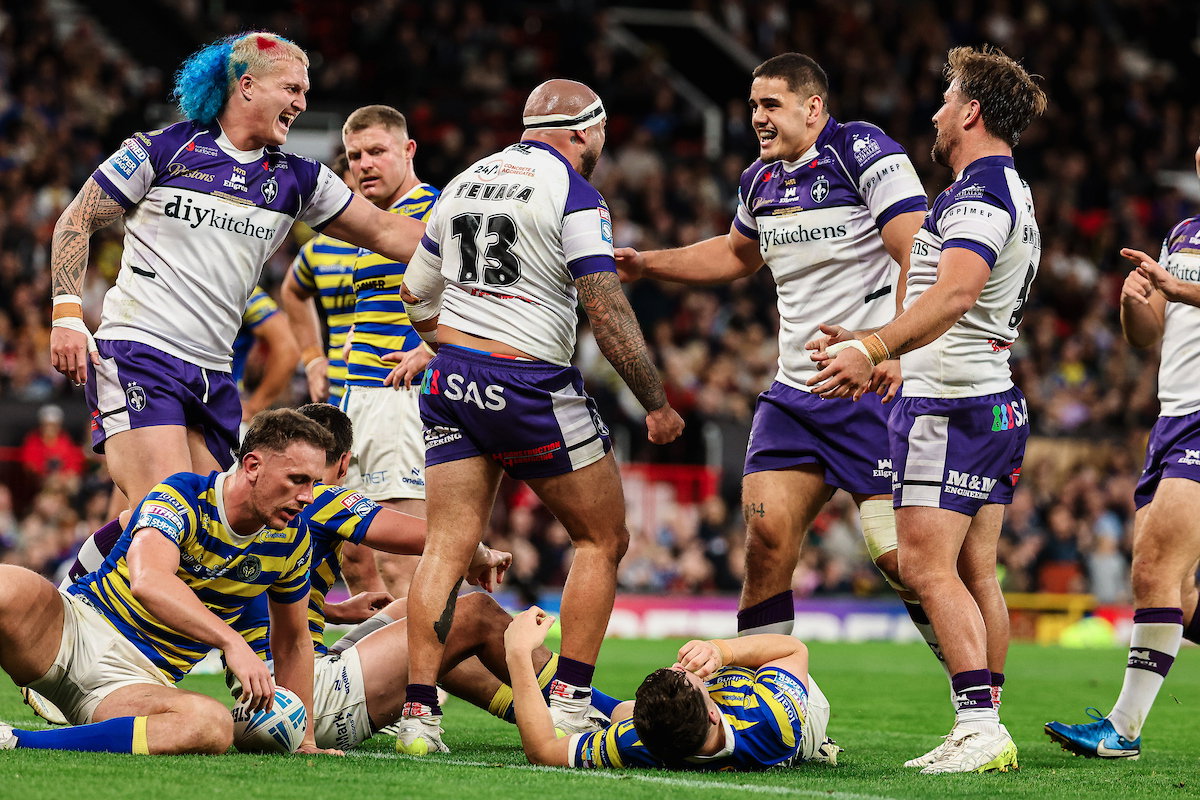
The stats behind the Super League Grand Final have been revealed, with Wakefield Trinity’s numbers showing exactly why they are deserved Champions.
Seeing off Warrington Wolves 23-10 at Old Trafford, Trinity became only the sixth team to claim the trophy in the summer era, and the second new winner in as many seasons after Hull KR in 2025.
No one gave them a chance heading into the play-off series, with Leeds and Wigan expected to play the big dance. However, both Wakefield and Warrington pulled off upsets in semis to make it to Manchester, before Trinity would cap off a tremendous season with a Grand Final winners’ ring.
But, how did we get to such a dominant Wakefield performance? Well, just like against the Warriors last week, it was the pack that dominated proceedings, and doing the basics immaculately went a long way to helping Daryl Powell become only the sixth English coach to win the Super League trophy.
Here is a breakdown of some key stats – Sam Burgess conceded at full-time that his side were matching Wakefield in the numbers at half-time, but it was their execution that let them down. The stats below suggest as much, with both sides completing sets very highly.
Super League Grand Final stats breakdown
*All stats are taken from the Super League website and are correct at the time of writing
Warrington had more carries than Wakefield, but their metre-making was far inferior to that of their victorious opponents. Carrying the ball 224 times, they made 1342 metres across the game (average of 5.99m per carry). Trinity had 21 fewer carries than Wire, but made 169 more metres (average of 7.44 metres per carry).
Metres after contact proved to be the difference, with Wakefield racking up 699 and Wire making just 559. The packs proved pivotal too, with Trinity’s middle unit making a whopping 704m compared to 424 of Warrington.
Mike McMeeken (107), Jazz Tevaga (111), Caleb Hamlin Uele (136) and Isaiah Vagana (116) all racked up three figures in the metre charts – Luke Yates was Warrington’s highest metre-making middle with 83.
The backs battle was a lot more even, but there was still a clear gulf between the two. Trinity’s starting back five amassed 745m, with 232m coming from Rob Burrow Award winner Tom Johnstone. Warrington only made 612m, with Albert Hopoate being their highest with 157m.
Scoreboard pressure is an incredibly valuable thing in finals, so Jack Sinfield’s one-pointer before the half-time hooter made for a four-score lead, cementing Trinity’s victory at that point.
The error charts were level, with both sides making seven mistakes across the game. Warrington missed a total of 36 tackles compared to Trinity’s 28. Wolves forward Joe Philbin missed seven of those 36, with Cam Scott, Corey Hall and Jake Trueman all missing four for Trinity.
The full Super League Grand Final team and player stats can be seen here.